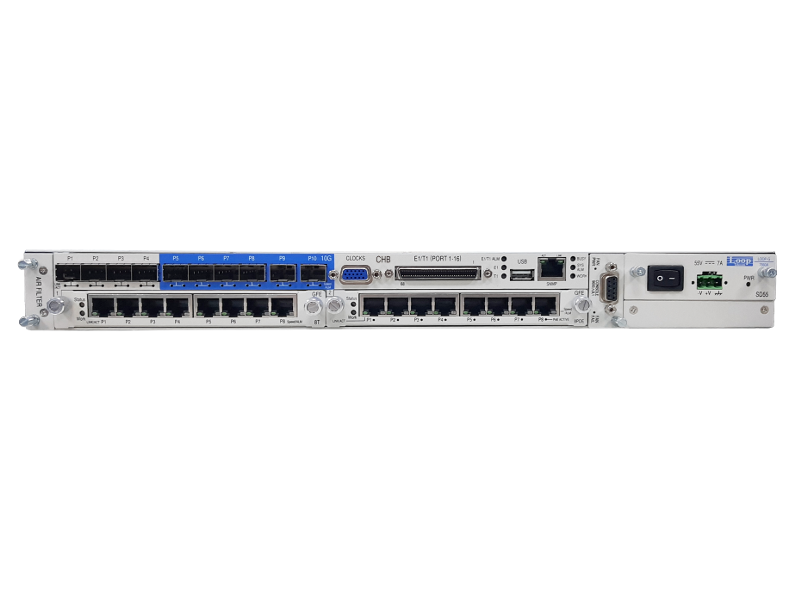
PTN – 10GE MPLS/CE Access Node – G7860A – PTN
G7860A là node truy nhập cho mạng truyền tải gói 10GbE (MPLS-TP hoặc Carrier Ethernet), hỗ trợ cả tín hiệu TDM (DS0, E1/T1, STM-n/OC-n) qua giả lập kênh; đồng bộ bằng SyncE và IEEE 1588v2.
Thông số kỹ thuật giữ nguyên bản tiếng Anh của hãng để bảo đảm chính xác. Cần bản giải thích tiếng Việt, hãy liên hệ kỹ sư NQC.
Mô tả
G7860A supports both MPLS-TP and Carrier Ethernet (EPL, EVPL, EPLAN, EVC defined in MEF) for packet transportation. In addition to native Ethernet transport, G7860A can be used as the gateway for PDH and SDH/SONET networks to enter PSNs using Circuit Emulation and Encapsulation technologies. Encapsulation technologies include TDMoE, TDMoIP, and TDMoMPLS. Circuit Emulation includes CESoPSN (NxDS0/64K) with CAS, SAToP (Unframed E1/T1), T3, and CEP (SDH/SONET paths). Pseudowires make grooming and multiplexing DS0, E1/T1, T3, and SDH/SONET paths easier, and service integrity can also be monitored and protected via packet network protection schemes.
One G7860A with up to 81G packet switching capacity supports six GbE/10GbE SFP+ and four 1GbE SFP built-in interfaces along with 16 E1/T1 built-in ports. With two hot-swappable plug-in slots, the system capacity can be scaled up with additional E1/T1 and T3 ports, STM-n/OC-n, or GbE electrical/optical interfaces.
G7860A provides high availability and reliability required by Carrier, Power Utility, Military, Government, and Transportation applications by supporting MPLS-TP LSP 1:1/1+1 protection and ERPS, with protection switching time <50ms. Ethernet and MPLS section and end-to-end OAM are also provided for monitoring service integrity and performance. The compact G7860A is only 1U height, but its powerful functions enable customers to provision a service-grooming hub, ring, or mesh 10G packet network with ultimate ease.
Tính năng
Cơ khí và điện
- 1U height, 19” width ETSI unit (front access)
- Power supply: hot swappable DC/AC, dual for redundancy
- Operating Temperature: -20 ºC to 65 ºC
Dung lượng hệ thống
- Up to 6 x 10GbE SFP+ ports
- Up to 16 x 1GbE Base-T
- Up to 20 x 1GbE SFP
- Up to 80 x E1/T1 ports
- Up to 8 x STM-1/OC-3 ports or 2 x STM-4/OC-12 ports
- Up to 4 x STM-1/OC-3 MSP pairs or 2 x STM-4/OC-12 pairs
- 16 x E1/T1 ports with SCSI interface
- Up to 8 x PoE/PoE+ ports
- Up to 4 x PoE/PoE+/PoE++ ports
MPLS-TP
- Any Ethernet port can be configured as NNI (MPLS port) or UNI (Ethernet service port)
- Bi-directional LSP
- Static LSP/PW provisioning via NMS
- Ethernet (VPWS, VPLS, H-VPLS) and TDM (CESoPSN, CEP, and SAToP) services
- MPLS-TP OAM and QoS
- TDM PW Support:
- 32 TE1 card: up to 256 pseudowires
- MB E1/T1: up to 256 pseudowires
- B16 card: up to 512 pseudowires
- DS3 card: up to 168 pseudowires
Carrier Ethernet
- L2 Switching/Bridging
- STP, RSTP, MSTP
- LLDP
- Port based VLAN and port isolation
- VLAN Stacking (Q-in-Q)
- CE OAM
- CFM: Ethernet Service OAM (802.1ag/Y1731)
- EFM: Ethernet Link OAM (802.3ah)
- Flow Control
- Link Aggregation Control Protocol (LACP)
- Jumbo Frame (MTU) = 9600
- EPL, EVPL, EP-LAN, EPV-LAN, EP-Tree
- E-Access: EPL-Access, EPVL-Access
Bảo vệ mạng
- MPLS-TP
- LSP 1+1/1:1
- LSP E2E protection switching < 50ms
- PW Redundancy
- Based on TP OAM for fault detection< 50ms
- CE
- ERPS Ring (G.8032) Protection
- ELPS (G.8031) Linear Protection< 50ms
- SDH/SONET
- STM-n/OC-n MSP 1+1 Protection
Quản lý
- Fully manageable via SNMP (v1, v2, v3)
- Fully manageable via CLI
- Serial port
- SSH, Telnet via Ethernet
- GbE Interface in-bands
- Account Security
- Two types of privileges: Operator (read only) and Administrator (read and write)
- Radius Client and 802.1x Authentication
- Upload/Download NE configuration
- TFTP
- SFTP
- Syslog, NTP
TDM Pseudowire Services
- Circuit Emulation
- DS0 (64K timeslots): CESoPSN (NxDS0/64K) with CAS & multiframe PW
- Unframed E1/T1: SAToP PW
- VC-3/4/11/12, VT-1.5/2, STS-1/3: CEP PW
- PDH Timing recovery: ACR/DCR/System
- ACR/DCR support
- 32TE1 card: up to 32 instances
- MB E1/T1: up to 16 instances
- B16 card: up to 256 instances
- SDH Circuit Emulation over Packet (CEP)
- Encapsulation
- PW/LSP (TDM over MPLS-TP),
- MEF 8 (TDM over Ethernet),
- TDM over IP
- PDH cross-connection to SDH/SONET
- DS0 cross-connection
- Two-way FE1(N*DS0) to FE1/VC12/STM1 cross-connection
- Two-way FE1(N*DS0) to FE1(N*DS0) cross-connection
Ethernet Pseudowire Services
- E-Line, E-LAN, E-Tree services as defined by MEF 9 and 14 and using VPWS/VPLS
- Native Ethernet packets supported
- Encapsulation: PW/LSP (MPLS-TP), VLAN tagging (1Q), VLAN double tagging (Q-in-Q)
VPLS
- VPLS & H-VPS bridging
- 32K MAC addresses
- 256 VPLS instances per device
- Split horizon to prevent forwarding loops
CoS/QoS
- 8 Priority Queues
- Scheduling: Strict Priority, WRR with Hierarchy
- Ingress Policing & Egress Shaping per service
- CIR / PIR (EIR) 2-rate-3-color
- MPLS: TC/EXP-Inferred-PSC (Per Hop Behavior Scheduling Class) LSP
Đồng bộ
- SSM quality level compatible
- IEEE 1588 v2 (via SyncE only)
- PTP Clocks: Ordinary/Boundary/Transparent
- ToD (Time of day) output performance
- 1-PPS (One Pulse per second) interface
- G.8265.1 Profile (Frequency Synchronization)
- SyncE
- Synchronous Ethernet from all built-in and plug-in GbE, 10GbE ports
- ITU-T Ethernet Synchronous Message Channel (ESMC)
- Stratum 3 timing
- TDM line clock: E1/T1
- External clock input and output (2 Mbps / 2 MHz / 1.544 Mbps / PPS /ToD for Tx)
Bảo vệ phần cứng
- Dual-power redundancy per box
- Dual-box redundancy
- E1 port protection across two boxes
- Ethernet port LAG across two boxes
- STM-1/4 port MSP across two boxes
Định tuyến lớp 3
- VRF without multicast protocols
- ARP, Ping, Trace Route, Static Route
- VRRP
- RIP v1/v2
- OSPF
- Routing among Physical Ethernet ports, VLAN virtual port (VLAN routing), and PW ports.
- 32 Subinterfaces
- IGMP v2/v3
- PIM-SM
- NTP server/client
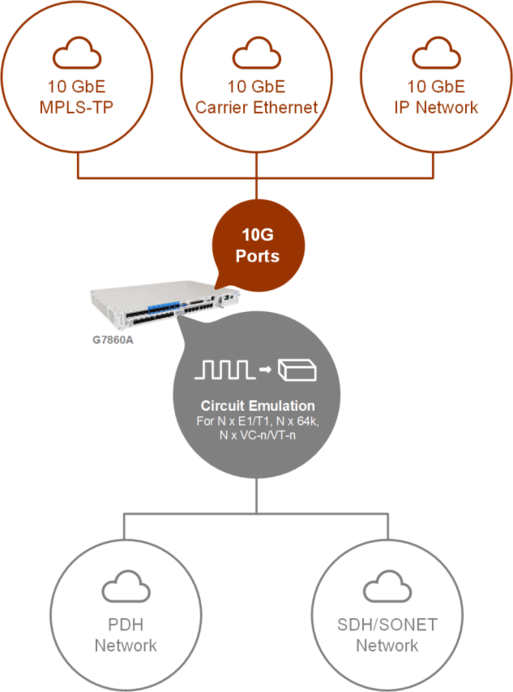
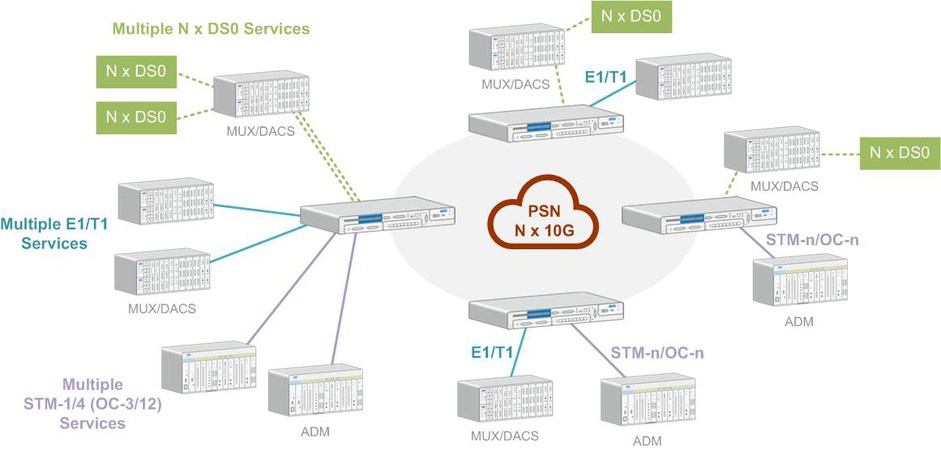
In addition to native Ethernet traffic, TDM circuits including DS0 timeslots, E1/T1 channels, and SDH/SONET paths can all be emulated as packets via pseudowires, multiplexed by G7860A, and switched to different sites via packet networks.
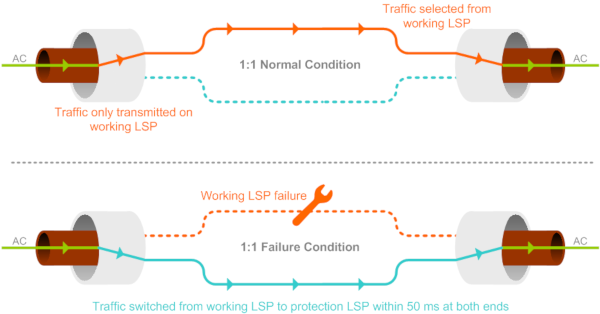
Protection scheme of an MPLS-TP network is standardized as part of the protocol. By deploying static nodes in the network, traffic transported by a tunnel between remote ends is protected by two label switching paths (LSPs) to achieve 1:1 or 1+1 protection.
In 1+1 mode, traffic is copied onto both working and protection LSPs. When receiving traffic, the remote LER only selects traffic from one of the two LSPs to decapsulate.
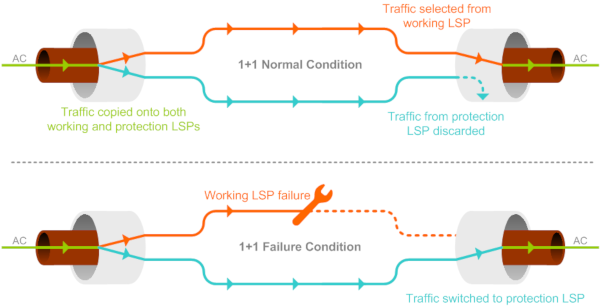
In 1:1 mode, traffic flows only on the working LSP. When a failure occurs on the working LSP, traffic is then switched to the protection LSP within 50 ms.